
.jpg)
12 principles to reframe the ‘learning crisis’ for demonstrable impact: Lessons from accelerated learning programmes in Ethiopia, Liberia and Ghana
by Kwame Akyeampong and Sean Higgins
December 2025
The narrative of Africa’s ‘learning crisis’ has become familiar: millions of children in school but not learning basic skills. Yet this framing often obscures more than it reveals. The real crisis lies not in children’s capacity but in systems that fail to build on their strengths, languages and lived realities.
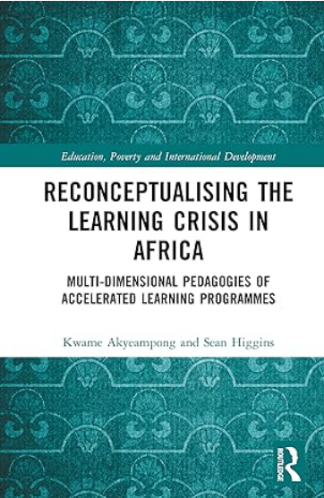
Our new book, Reconceptualising the Learning Crisis in Africa, examines three Accelerated Learning Programmes (ALPs) that achieved what conventional schooling often cannot: deep, lasting learning for children who had dropped out or fallen behind. Ghana’s Complementary Basic Education (CBE) Programme has reached over 250,000 learners at national scale. Ethiopia’s Speed Schools served more than 200,000 children by 2017, condensing three years of primary education into one without sacrificing comprehension. Liberia’s Second Chance Programme has supported over 5,000 learners whose education had been disrupted by conflict or poverty.
These programmes succeeded not by importing global prescriptions, but by centring what matters most: children’s home languages, community knowledge, teacher professionalism, and relationships built on trust and care. From this evidence, we propose twelve interlinked principles – a practical framework for policymakers and funders seeking demonstrable, sustainable impact.
From ‘What Works’ to ‘What Works Where’: Twelve design principles
Principle 1: Recognise and build on what children and families already know. Cultural and experiential knowledge are powerful learning assets, not deficits to overcome. Ghana’s CBE facilitators used local farming practices, market experiences and community events as entry points for numeracy and literacy – making abstract concepts immediately relevant.
Principle 2: Replace deficit narratives with possibility. Children’s resilience, creativity and curiosity must anchor interventions. Ethiopia’s Speed Schools demonstrated that children previously labelled as ‘behind’ could master three years of content in one year when pedagogy started from recognising and building on their strengths.
Principle 3: Map community languages before designing curricula. Language shapes cognition and connection. Ghana’s CBE systematically mapped the 11 languages across programme sites, ensuring instruction began in languages children actually spoke at home – a practice that produced measurably stronger early literacy outcomes.
Principle 4: Make curricula meaningful. Content must align with local contexts, identities and aspirations. All three ALPs adapted national curricula to reflect children’s lived environments, from Liberia’s post-conflict realities to rural Ethiopian farming communities whilst achieving strong learning outcomes.
Principle 5: Use local languages more consistently and for longer. Early transition to foreign languages alienates learners and widens inequalities. UNESCO’s 2025 ‘Languages matter: Global guidance on multilingual education’ report states that in Africa, children who learned in a familiar language were 30% more likely to read with understanding by the end of primary school compared to those taught in an unfamiliar language. Despite this, many education systems transition to second languages by grade 2 or 3, well before children have consolidated foundational skills and/or do not learn in a familiar language at all.
Principle 6: Focus on holistic learning, not just test scores. True learning encompasses cognitive, social and emotional growth. Liberia’s Second Chance Programme explicitly cultivated children’s sense of safety, belonging and agency – outcomes that enabled academic progress but matter far beyond assessment metrics.
Principle 7: Treat communities as partners, not passive recipients. Community participation grounds education in shared values and accountability. Ghana’s CBE required community oversight committees, local recruitment of facilitators, and regular community meetings – ensuring programmes remained responsive and culturally grounded.
Principle 8: Put pedagogy at the centre of reform. Learning depends less on inputs than on how teachers teach and children learn. All three ALPs prioritised interactive, dialogic teaching over rote memorisation, creating classrooms where questioning, collaboration and problem-solving drove understanding.
Principle 9: Value teachers’ professional knowledge. Teachers are co-creators of learning, not implementers of scripts. Ethiopia’s Speed School facilitators were trusted to adapt lessons based on children’s progress and needs – a form of professional autonomy that links to better outcomes with the right support.
Principle 10: Support teacher growth through reflection and collaboration.Professional learning communities nurture innovation from within. Ghana’s CBE established regular peer-support groups for facilitators, enabling shared problem-solving and continuous improvement without reliance on costly external training.
Principle 11: Ground education in Ubuntu. Learning should cultivate empathy, interdependence and moral purpose. Liberia’s Second Chance Programme embodied this Ubuntu philosophy by emphasising care, compassion and collective responsibility as foundations for both academic and social learning.
Principle 12: Challenge stereotypes and exclusion. Gender, disability and social class must never determine learning potential. All three ALPs deliberately reached marginalised children – girls in rural areas, children with disabilities, those affected by poverty or conflict – demonstrating that equity and excellence are mutually reinforcing, not competing goals.
What it takes to implement: Practical implications
For ministries of education, these principles translate into concrete policy actions:
- Strengthen and extend mother tongue instruction timelines. Shift language-in-education policy to maintain home language instruction through at least grade 3, with gradual transition supported by bilingual materials and teacher preparation.
- Invest in teacher professional communities. Allocate protected time for peer collaboration, co-planning and classroom observation. These cost-effective structures build capacity from within rather than through external support.
- Strengthen formative assessment and instructional leadership. Move beyond high stakes testing toward continuous assessment that informs teaching. Train head teachers and supervisors as pedagogical leaders, not just administrative managers.
- Align curriculum, materials and assessment coherently. Conduct systematic alignment reviews, prioritising consistency in language of instruction, pedagogical approach and learning expectations across these three critical system components.
For development partners and funders, the implications are equally clear:
- Shift from projectisation to partnership. Support long-term institutional capacity rather than short-lived pilot programmes. Ghana’s CBE evolved through sustained collaboration between government, communities and civil society – a model that builds ownership and sustainability.
- Fund what matters most. Prioritise investments in teacher professional development, community language materials and pedagogical coaching over infrastructure or technology. The ALPs demonstrate that effective learning depends primarily on human relationships and culturally responsive practice.
- Redefine success metrics. Move beyond narrow literacy and numeracy scores toward indicators that capture children’s agency, belonging and confidence. These harder-to-quantify outcomes are vital to long-term learning and social cohesion.
A way forward: Learning from Africa’s own innovations
The accelerated learning programmes in Ghana, Ethiopia and Liberia offer a powerful counter-narrative to deficit thinking. They demonstrate that deep learning is possible, even under conditions of scarcity, when education begins with children’s worlds rather than external expectations.
These programmes achieved measurable gains not through standardised scripts or imported models, but by trusting teachers as professionals, honouring children’s languages and cultures, and building genuine partnerships with communities. They remind us that learning is relational, cultural and moral – far more than skills acquisition.
If we truly seek demonstrable impact, we must redefine ‘what works’ to include not only test scores but also identity, dignity, and hope. That is the lesson from Ethiopia, Liberia and Ghana – and the promise of a learning future shaped by Africa’s own philosophical values.
The What Works Hub for Global Education has a critical role in amplifying these African-led innovations, helping to reframe global debates about what truly works – and for whom. The evidence is clear: when we centre children, trust teachers and honour communities, transformation follows.
References
Akyeampong, K. & Higgins, S. (2025). Reconceptualising the Learning Crisis in Africa: Multi-dimensional Pedagogies of Accelerated Learning Programmes. Routledge.
UNESCO. (2025). Languages matter: Global guidance on multilingual education. Paris, France: UNESCO. https://unesdoc.unesco.org/ark:/48223/pf0000392477
Acknowledgement
This blog was first posted by the What Works Hub for Global Education
Connect with us
Whatever your reasons for wanting to connect with us, you can contact us via email or social media on the addresses below
CSGD email
CSGD on Bluesky
CSGD on LinkedIn
Sign up to our mailing list to receive the latest news on our research, events and publications.
Sign up to our mailing list


Explore

Undergraduate
Postgraduate
Policy
-
Follow us on Social media
-


