
.jpg)
CSGD January 2026 Newsletter
January 2026
Welcome!
Welcome to the Centre for the Study of Global Development (CSGD) newsletter, where you can find our latest news, publications and upcoming events.
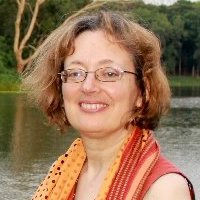
Imagination! Nelson Mandela’s words, “A better world starts with imagination”, sit in my email sign‑off and stay with me every day. The power of imagination can fuel the creativity and innovation we urgently need as we try to navigate these times of crises and uncertainty.
It is no surprise, then, that imagination runs through this newsletter. We are invited to envision a world where policies prioritise both people and planet, over a relentless quest for economic growth. We are encouraged to consider how new global research talent might be nurtured outside today’s inequitable and precarious systems. We celebrate young women in Zimbabwe finding new livelihoods through alternative learning pathways, and the launch of a toolkit for Afrocentric Pedagogical Leadership.
These acts of re‑imagining require collective time, challenge and debate. This is why we are reshaping our external events into a year‑long series of curated conversations—creating space for diverse voices, deeper thinking and ongoing connection. As a precursor, you may be interested to reflect on Advisory Board member, Andy Brock’s collection of 26 predictions for education in 2026, which sparked ideas for me far beyond the education sector.
This year, we hope to bring together even more strongly our intellectual curiosity, imagination and courage and, as our Deputy Director, Keetie Roelen, reminds us, to take “action, a response to the injustice that is staring us in the face.”
CSGD Manager
News
Introducing CSGD Advisory Board
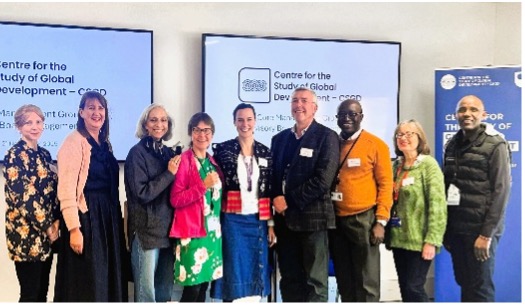
We are delighted to introduce our new Advisory Board. Chaired by Freda Wolfenden, the Board offers expert advice and guidance to the Centre on future research areas, potential partnerships, emerging policy agendas and amplifying knowledge exchange. Our external members are Andy Brock, former Managing Director of Cambridge Education; Kavita Ramdas, global advocate for gender equity and justice; Laura Camfield, Head of Department of International Development, King’s College London; and Moses Ngware, Head of Education and Youth Empowerment Research Unit, African Population and Health Research Center. They are joined by Klaus-Dieter Rossade, Executive Dean and Vice Chancellor’s Executive Team member, The Open University; Alison Buckler, CSGD Director; Keetie Roelen, CSGD Deputy Director; and Kwame Akyeampong, CSGD Founding Director.
Publication of CSGD Annual Report 2024-25
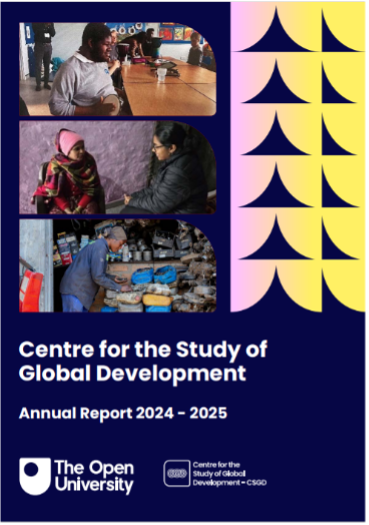
Our Annual Report highlights the people, partnerships and research driving CSGD - from tackling inequalities and extreme poverty to improving access to quality education and healthcare worldwide. It includes thought pieces on global and interdisciplinary perspectives, collaboration and methods innovations.
The report reflects the many contributions, insights and provocations of our partners and community – thank you all so much. In 2026, we want to amplify our collective debate and collaboration on research that pushes boundaries in an increasingly polarised world in the pursuit of human wellbeing and social justice.
Alison Buckler, CSGD Director, emphasises that the Centre’s strongest research “listens to, learns from and connects those most affected by a development challenge with those who can address it.”
Eradicating Poverty Without Growth: Can It Be Done?
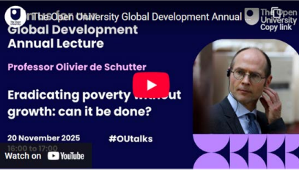
On 20 November, the OU Global Development Annual Lecture was co‑hosted by CSGD, the IKD Group at the Faculty of Arts and Social Sciences, and the OU’s Open Societal Challenges. Professor Olivier De Schutter, United Nations Special Rapporteur on Extreme Poverty and Human Rights, challenged the premise that economic growth alone can end poverty. He argued that the quest for growth can be counterproductive: it drives environmental harm, creates “burnout economies”, and leads to policies that worsen the very problems of social exclusion and inequality it seeks to solve.
This was a call to action - for policies that serve both people and planet. Kavita Ramdas’ reflections then sparked debate about the shifts in imagination this requires.
Launch of Afrocentric Pedagogical Leadership Toolkit

In January, CSGD member, Eric Addae-Kyeremeh, launched an Afrocentric Pedagogical Leadership Toolkit co‑created by The Open University and the University of Cape Coast working with educators in Ghana.
The toolkit has emerged from long‑standing collaboration with teachers, school leaders, communities, and partners across Africa. It reflects a central insight: pedagogical leadership is most meaningful when it is grounded in the cultural, social, and lived realities of the people it serves.
Eric says, “Our intention was not to add another leadership framework, but to offer a resource that honours African ways of leading and learning, while supporting educators to reflect, adapt, and act with cultural confidence”.
This Open Educational Resource is designed for reuse, adaptation, and critical engagement across settings.
Healing Classrooms Course with International Rescue Committee
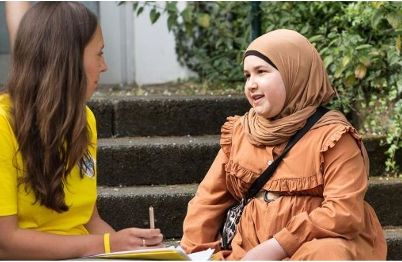
CSGD member, Koula Charitonos, has played a leading role in The OU’s partnership with the International Rescue Committee (IRC) to launch their Healing Classrooms module on The OU's OpenLearnCreate platform.
Drawing on decades of research and field-testing, the Healing Classrooms programme has supported children and young people in more than 20 countries, in conflict-affected zones and resettlement countries, to heal from trauma and toxic stress.
The module brings IRC’s world-leading expertise and The OU’s online‑learning practice into a free of charge, self‑paced course. It is particularly relevant for UK-based educators working in mainstream settings, but also offers valuable insights for educators, wherever they are, seeking to welcome refugee learners and foster a sense of belonging for all children.
SAGE Wins International Collaboration of the Year!
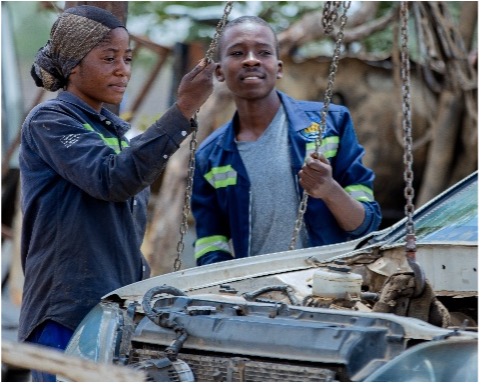
The OU’s partnership within the Plan International led consortium for the Supporting Adolescent Girls' Education (SAGE) project won International Collaboration of the Year at the 2025 Times Higher Education Awards. The project aims to transform education for adolescent girls in Zimbabwe.
The judges said, “The broad coalition of stakeholders that SAGE brought together to create a sustainable approach to address a shared challenge is an example of the very best aspects of international collaboration.”
Following the award, Alison Buckler, CSGD Director, co-facilitated a national symposium, ‘Non-Formal Education: Unlocking Potential, Transforming Lives’, in Zimbabwe. Primary and Secondary Education Minister, Torerayi Moyo, described non-formal education as “an engine that offers crucial lifelong learning in line with Sustainable Development Goal 4.”
Fieldwork Spotlight: Supporting Caregivers and Children Living with HIV in South Africa
Emil Dauncey, co-lead of our Poverty, Inequality and Social Protection Hub, has been carrying out fieldwork in KwaZulu-Natal, South Africa on a long-standing but often misunderstood challenge: paediatric HIV treatment adherence. This Open Societal Challenges initiative began when Chiva Africa, an organisation supporting children and adolescents living with HIV, approached The OU for help.
Early insights are already reshaping how adherence is understood. Caregivers are often blamed when treatment falters, yet their daily realities are shaped by forces far beyond their control. What is becoming clear is that paediatric care depends on a wider system of relationships, between households, clinics, health workers, and communities.
Learn more in CSGD Policy Brief #12.
Global Development PhD Awards: Where Next?
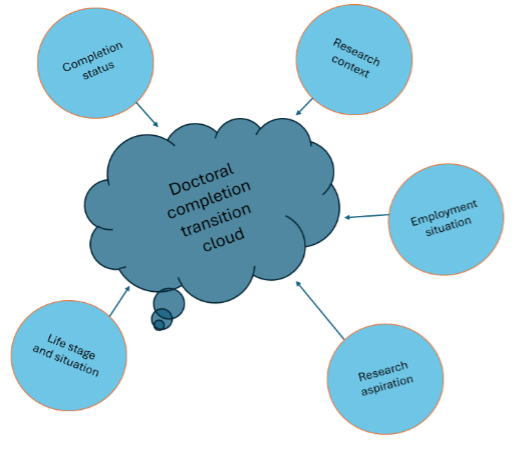
As OU Visiting Fellow and CSGD Early Career Research Lead, Lesley Boyd will present at a British Academy ECR Network event in London on Equity, Diversity and Inclusion (EDI) in Tumultuous Times: Precarity, Power and Possibility in Higher Education. This will take another step in raising awareness of supporting inclusive research careers, especially across all age ranges, as a national and global societal challenge.
Building on our ECR Lead work and Forum meetings as featured in the CSGD annual report, Lesley will highlight the complex challenges of navigating doctoral completion and - where next? A critical exploration of how precarity intersects with EDI, the event asks what new imaginaries and strategies might tackle deep-rooted structural inequalities.
Research and Programme Collaboration with the Arab Open University
Jane Cullen, co-lead of our Learners and Learning Hub, is contributing to a new phase of The OU’s partnership with the Arab Open University (AOU). This follows the recent visit by the AOU to The OU, where a diverse range of educational synergies between the institutions were discussed extending beyond current programmes in business, computing, education and language studies.
This new aspect of our collaboration is building on CSGD research expertise in educational technology and educational leadership to support first steps for AOU towards introducing postgraduate research in the form of a PhD programme. Forthcoming workshops in Jordan, co-led by AOU colleagues and Jane, will develop plans for collaborative supervision at both masters and doctoral level.
Catch Up Learning, UNGA80 and NORRAG Policy Insights
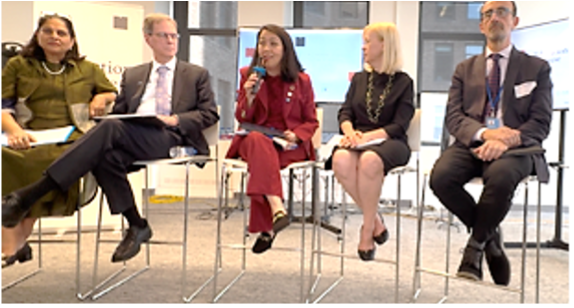
At the 80th United Nations General Assembly, CSGD member, Alexandra Okada, presented groundbreaking research on education in crisis, that collaboratively explored World Vision: Catch Up Learning. Speaking in World Vision’s panel, From the Margins to the Centre: Transforming Education Systems Where It Matters Most, she challenged a fundamental assumption, that children affected by conflict, displacement, and climate emergencies need only academic recovery. They need emotional safety, confidence, and agency.
Our recent contribution to NORRAG Policy Insights - Education and the Humanitarian-Development-Peace Nexus at 10, ‘Messy, hard, rewarding! Figuring out together catch up learning across the nexus’ highlights the imperative to affirm learning as a life-saving priority, to integrate social-emotional learning, and to invest in community-led capacity.
Upcoming CSGD Events
We are re-envisioning our CSGD events to create a series of curated conversations that enable and stimulate ongoing debate.
Please look out for news of our first conversation of 2026, Could, and should, global development research be framed as an act of transformational solidarity? Coming soon!
Alongside colleagues from Nigeria and Uganda, CSGD members, Freda Wolfenden and Zaharah Namanda, are co-authors of an upcoming White Paper. Please join them at the Launch of the ETI White Paper: Quality TPD at Scale: Policy Considerations for the Next Decade in Africa.
When: Wednesday, February 11, 2026
Time: 14:00 - 15:30 (GMT)
Event Type: Online via Zoom
Online registration to join the event.
Publications
Recent publications include:
Addae-Kyeremeh, Eric; Ebubedike, Margaret; Kwaah, Christopher Y.; Cullen, Jane and Agyei, Christian (2026). Afrocentric Pedagogical Leadership: A toolkit for educators in Ghana. The Open University, Milton Keynes, UK.
Charitonos, Koula; Littlejohn, Allison; Dawadi, Saraswati; Vaidya, Abhinav; Owusu-Ofori, Alex; Goshtasbpour, Fereshte and Giri, Santoshi (2026). Fostering deliberation and action in context: an analysis of implementation research among healthcare professionals in LMICs from a post-digital perspective. British Journal of Educational Technology (In press).
Dauncey, Emil (2026). Relational research as practice: Policy-relevant lessons from a partnership in South Africa. CSGD Policy Brief #12
Hedges, Claire; Zwier-Marongedza, Janelle; Ebubedike, Margaret; Chidiac, Charbel and Okada, Alexandra (2025). Messy, hard, rewarding! Figuring out together catch-up learning across the humanitarian-development-peace nexus. In: Joyner, A. and M.V. Faul (Eds.). Education and the Humanitarian-Development-Peace Nexus at 10. Policy Insights #06. NORRAG.
Jackson, Lace and Copperman, Jeanette (2026). Navigating organisational contexts as women leaders. In: Alhuzail, Nuzha Allassad and Majumdar, Koustab eds. Indigenous Women's Resilience, Leadership and Social Change. Migration, Minorities and Modernity: Springer.
Nyanhete, Alois Itayi and Yeates, Nicola (2025). The effects of sending remittances on the financial capabilities of Zimbabwean migrants in the United Kingdom. Journal of International and Comparative Social Policy (Early Access).
Ribbens McCarthy, Jane and Hamilton, Sukhbinder (2026). Surrendering to death and its aftermath: Conceptual explorations in the era of coloniality/modernity. In: Pentaris, Panagiotis; Pitsillides, Stacey and Ghorbani, Hajar eds. Decolonising Death Studies. Routledge.
Rienties, Bart; Roelen, Keetie; Oakley, Ben; Duncan, Elaine and Pengel, Liset (2026). Multiple and Multi-dimensional Life Transitions of World Transplant Athletes. In: Jindal-Snape, Divya ed. The Palgrave Handbook of Multiple and Multi-Dimensional Educational and Life Transitions. Palgrave MacMillan (In Press).
Please feel free to share our newsletter with your contacts. If you received this email from a colleague and would like to be added to our mailing list, you can subscribe to our newsletter here.
Connect with us
Whatever your reasons for wanting to connect with us, you can contact us via email or social media on the addresses below
CSGD email
CSGD on Bluesky
CSGD on LinkedIn
Sign up to our mailing list to receive the latest news on our research, events and publications.
Sign up to our mailing list


Explore

Undergraduate
Postgraduate
Policy
-
Follow us on Social media
-


