
.jpg)
Giving back to the community behind the research
Reflections from a classroom dialogue dissemination workshop in Ghanaian schools
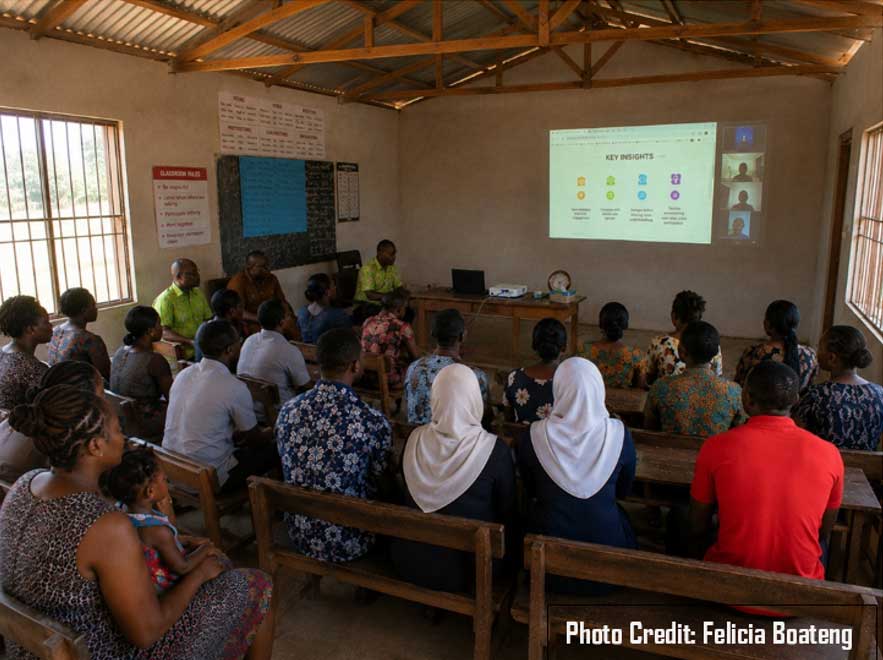
by Felicia Boateng
June 2026
Discussions around achieving quality education and the broader goals of SDG 4 have increasingly positioned 21st century skill at the centre of educational reform globally. Competencies such as communication, collaboration, creativity, and critical thinking are increasingly viewed as important for preparing learners for contemporary social and economic realities. Ghana’s 2019 Standards-Based Curriculum reflects these changing educational priorities, with communication and collaboration included among the core competencies expected to shape classroom practice, the particular area explored within this research.
An important question emerging from these curriculum priorities is what communication and collaboration actually look like in everyday classrooms. More specifically, does increased classroom interaction necessarily lead to meaningful dialogue and collaborative thinking?
Researching classroom interaction
These questions sit at the centre of my PhD research (2022-2026), which explores classroom talk in two lower secondary schools in Ghana. Using an ethnographic case study approach, the study drew on classroom observations, teacher interviews, student focus group discussions and exit tickets to examine how classroom talk is organised and perceived in practice, how it supports learning, and the factors shaping and sometimes constraining meaningful classroom interaction.
Returning to the communities
Following the completion of the analysis, I returned to the participating schools to share the findings through a hybrid dissemination and reflection workshop. Dissemination is not only positioned as a process of reporting findings back to participants, but can also become a space for dialogue, interpretation, validation, and collective reflection between researchers and practitioners.
The workshop evolved into a space of critical professional reflection where teachers engaged with the realities shaping classroom interaction within their schools. Teachers largely acknowledged that the findings reflected their classroom experiences, making the dissemination process itself an important point of validation for the study. Discussions reinforced the finding that while classroom talk was visible across lessons, interaction often remained predominantly teacher-led, with fewer opportunities for students to build on one another’s ideas or sustain deeper dialogue. Teachers also reflected on how emotional classroom climate, pressure to complete the syllabus, fear of mistakes, and language practices shaped participation in ways that are often less visible within policy discussions surrounding communication and collaboration.
Learning about and from non-participation
Interestingly, some of the most engaged contributors during the workshop were not necessarily the original research participants. Teachers who had not directly participated in the study actively connected the findings to their own classroom experiences, questioned existing practices and reflected critically on the challenges of facilitating interactive learning environments. This became particularly significant because the workshop demonstrated that non-participation does not necessarily equate to lack of interest or disengagement.
The active engagement of teachers beyond the immediate research participants also suggested that the findings resonated across similar classroom contexts, offering broader validation of the issues identified within the study. As the discussion progressed, the conversation moved beyond validating the findings towards deeper reflections on practice itself. Teachers repeatedly returned to the tension between curriculum expectations and classroom realities. Although communication and collaboration are increasingly emphasised within curriculum policy, several teachers reflected on the difficulties of facilitating meaningful classroom dialogue within existing classroom conditions.
Some of the reflective questions raised during the workshop included:
“… so what support can we get to help us facilitate an effective classroom dialogue?”
(Mathematics teacher_ School A)
“If other countries can use their local languages to support learning, why are we still struggling to do that here? What are we doing differently?”
(Social studies teacher _School B)
Dissemination workshop as a space for reflective thinking
These reflections were particularly significant because they showed that teachers valued productive classroom interaction but were struggling with the realities shaping its implementation. This reminded me in my reflection that the dissemination workshop did not only make the findings known to participants but also opened a space for collective thinking about the future of classroom talk in Ghana. In many ways, the workshop became a continuation of the inquiry through which teachers reflected on challenges, questioned existing practices and explored possibilities for creating more productive classroom dialogue. More importantly, the experience demonstrated that dissemination can itself generate new professional conversations that extend the life and relevance of research beyond the point of data collection and analysis
Acknowledgement: I gratefully acknowledge the support of the Centre for the Study of Global Development (CSGD), The Open University, whose dissemination funding made this engagement activity possible. I also extend my sincere thanks to the participating schools, teachers and school leaders for their support in facilitating the workshop and for their valuable contributions to the discussions and reflections shared during the session.
About the author:
Felicia Boateng is a PhD researcher in the Faculty of Wellbeing, Education and Language Studies (WELS) at The Open University, UK. Her research explores classroom dialogue in Ghanaian basic schools, with particular interest in how classroom interaction is perceived and practised to support learning. Her broader interests include qualitative research, teacher development, educational policy and practice, curriculum implementation and inclusive approaches to teaching and learning in diverse educational contexts.
Connect with us
Whatever your reasons for wanting to connect with us, you can contact us via email or social media on the addresses below
CSGD email
CSGD on Bluesky
CSGD on LinkedIn
Sign up to our mailing list to receive the latest news on our research, events and publications.
Sign up to our mailing list


Explore

Undergraduate
Postgraduate
Policy
-
Follow us on Social media
-


