
.png)
Yoker Resource Centre (Scotland)
Take Five is not just useful once. It’s useful to go over and over, because every time you see something new in it.
Angus, 72
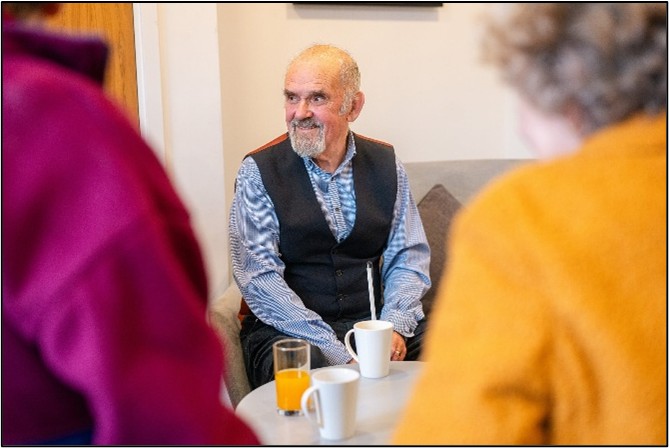
A group of older adults from the Yoker Resource Centre in Glasgow completed Take Five to Age Well as a team in 2025. The group attend the Time Well Spent programme, run by Kirsty Gibbons at the Yoker Centre, which is in one of the most deprived areas of Glasgow. Participants included people with long term conditions such as dementia and MS, COPD and stroke with mix of men and women aged from 58 to 96 years.
Kirsty Gibbons noticed Take Five through Age Scotland and found the evidence-based framework complimented the centre’s ethos for allowing group discussion and shared goals. In keeping with the principals of Take Five, Kirsty, used a co-production approach, “we didn’t deliver a programme “to” people; we worked collaboratively to interpret and implement each pillar into our lives”. Age Scotland provided a facilitators pack and Kirsty signed up to Take Five to receive all the emails with a raft of health literacy information. In this way, Kirsty said, “Take Five provided practical, evidence-based strategies that we could adapt for our community’s unique context”
Within ‘Eating Well’ the group discussed the challenges of limited shopping options in the area with 86-year-old Pete noting that he had never seen a fresh peach, only the tinned kind. Members chose to limit sweets to the afternoon and their interest about healthy food choices prompted Kirsty to plan future sessions with visiting professionals to explore nutrition in more detail. Meanwhile, the “Move” section of the workbook prompted a shift in the group’s routine as Jane suggested daily chair exercises to avoid sitting still all day; as she highlighted, “it’s all too easy to remain seated, leading to stiffness and discomfort”. From then on, the group set a daily reminder for a collective walk around the room or gentle stretching. Jane was particularly committed to this and her commitment and enthusiasm spurred everyone else to join in. This consistency in recall despite Jane’s experience of living with dementia was an unexpected reminder of the strengths and capacities that can sometimes be overlooked in older adults. It also demonstrates that Take Five can support learning and agency, even in the presence of cognitive impairment. These positive endorsements of Take Five from participants deepened Kirsty’s keenness to embed Take Five to Age Well into the group’s routine, ensuring activities are accessible, meaningful, and truly participant-led.
Take Five’s ‘Social Connection’ and ‘Cognitive Engagement’ facilitated deeper, more reflective conversations which were greatly enjoyed and fostered deeper friendships and cohesion across the group. Members valued the structured time to share stories, discuss habits, and reflect on differences. These conversations brought laughter, new insights, and a sense of belonging. “We talk every week, but these conversations were different. They gave us space to say things we wouldn’t normally say, and it’s changed how we think.” – Stan, 66.
Overall, the group was consistently engaged with the Take Five delivery – attendance to the group was high and over 70% of members choosing to adopt at least one new health action. The influence of Take Five extended beyond the meetings at the Yoker Centre; family members noticed positive changes at home—such as healthier eating habits and increased engagement with participants often talking about what they had learnt as part of Take Five. It also extended to staff and volunteers as they gained confidence and new skills through guided reflection and practical involvement with the health topics.
“The Take Five to Age Well programme has been a valuable resource—offering a robust academic framework that could be adapted to local realities. Take Five aligns with our commitment to co-production, adaptability, and member empowerment and has allowed us to build on our strengths and deliver even greater impact for our community. It has been transformative for our Time Well Spent group and its wider community. By embedding the Five Pillars of Ageing Well into everyday practice, we have created a culture of connection, empowerment, and lifelong learning—demonstrating that research-led interventions can be engaging, impactful and deeply accessible in the real world.” – Kirsty Gibbons.
Photos courtesy of the Centre for Ageing Better’s Age Positive Image Library



Explore

Undergraduate
Postgraduate
Policy
-
Follow us on Social media
-


