

Howled and muck versus shrugs and laughs: Nature and emotions in YA fiction
Howled and muck versus shrugs and laughs: Nature and emotions in YA fiction

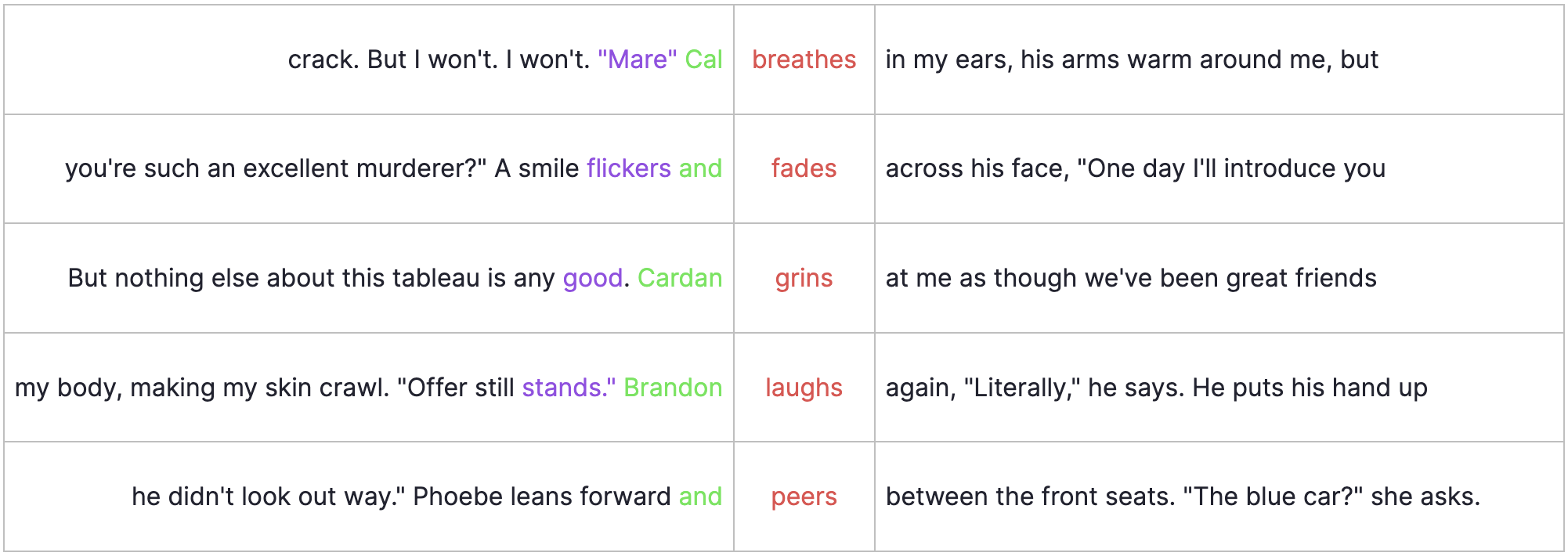
Which of the following sets of examples would you guess is from male-authored YA fiction and which from female-authored? (these aren’t full sentences so you’re just reading the central words in red with a few words around them to give some context).
A
B
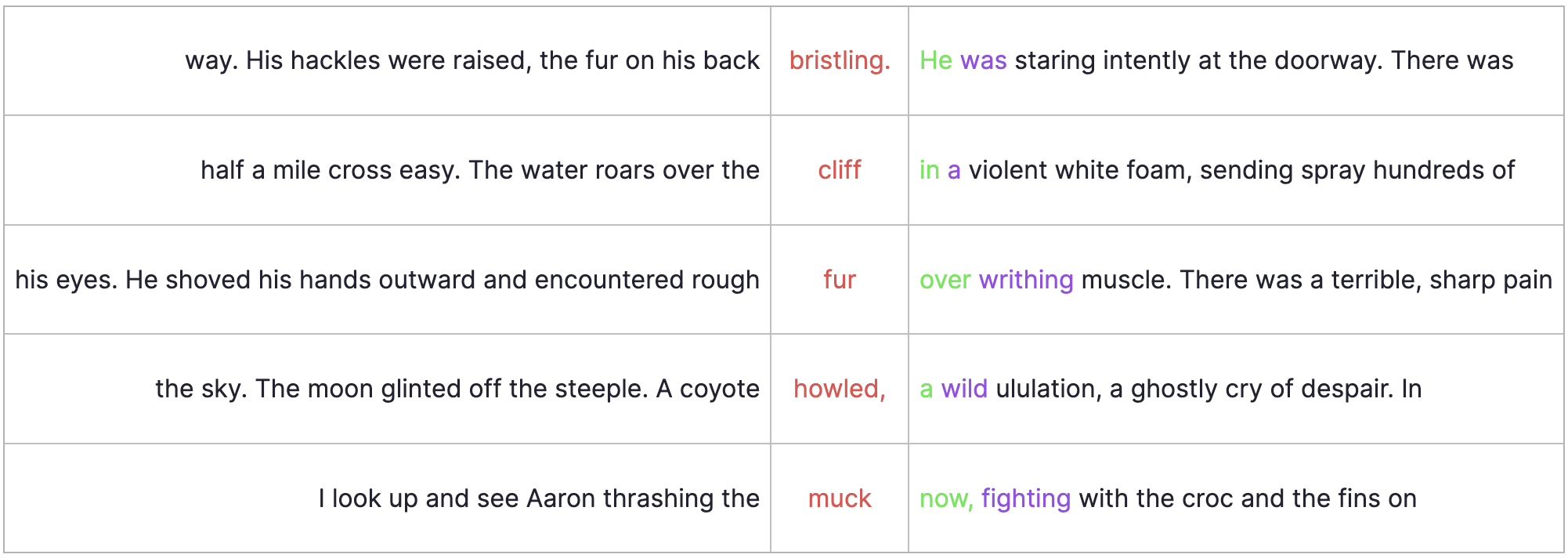
We’d hazard a guess that you thought the example lines in A were from books written by women and those in B from books by men. If you did – you’re correct!
All the examples were taken from our current research which explores the overarching themes in YA fiction by female authors and compares these with books by male authors. We found that female-authored books have many more words connected with people – describing appearance, feelings and relationships – whereas male-authored YA books have a great many words associated with nature.
Female authors in the corpus use lots of words which reveal characters’ emotions and their reactions to other people. These small actions are often from the ‘neck up’ such as raising an eye brow (Example 1 below), brushing a strand of hair (2), head tilting (3), locking eyes (4), shrugging (5) or laughing (6) (the words in bold are our keywords – words which occur more often in the female-authored books ‘DoRA-F’ than in the male-authored books ‘DoRA-M’).
- Phoebe arches a skeptical brow, and I guess I can’t blame her for asking. [One of Us is Next by Karen McManus]
- I gently brush the dark, thick hair back behind her ear. [The Hunger Games by Suzanne Collins]
- She tilts her head and gazes out over the dash at some distant point as if she’ll see the answer there. [All the Bright Places by Jennifer Niven]
- Cal locks eyes with his old friend and nods. [Red Queen by Victoria Aveyard]
- “I’m gonna talk to her and stuff. Okay? But you’ve got to let me handle it.” He shrugs. [Simon vs. the Homo Sapiens Agenda by Becky Albertalli]
- She laughs, and a comfortable silence settles over the both of us until she goes off to get some lunch. [Five Feet Apart by Rachael Lippincott]
In contrast, male authors in our corpus write a lot about their characters grappling with the raw, natural environment – in these stories people clambered, scrambled (Example 7), tumbled and crouched (8) as they contend with cliffs, cobwebs, flood, fog, muck(10) and more. Here, the bold items occur statistically more frequently in DoRA-M when compared to DoRA-F.
- He scrambled to his feet, searched the floor around him for a weapon. [The Maze Runner by James Dashner]
- “Exhausted,” he squeaked as we crouched beside him. [Skellig by David Almond]
- [...] listening to it felt like standing on a mountain top as a wind blew away clouds of fog and mist [..]. [The Secret Commonwealth by Philip Pullman]
- I’m still down on my belly in the muck, where I fell when Aaron - [Knife of Never Letting Go by Patrick Ness]
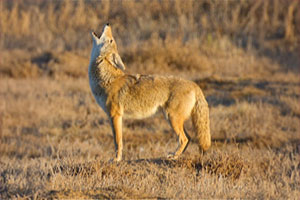
Animals feature more heavily in books by men, and as well as animals and animal parts (beak, jaws, sheep, squirrel), actions associated with animals are common. Thus, both animals and people are more likely to howl in male-authored YA fiction (Examples 11 and 12).
- A coyote howled, a wild ululation, a ghostly cry of despair. [Gone by Michael Grant]
- Emma squeezed harder and closed her eyes and howled, not a cry of pain, I thought, but a kind of war cry, [...] [Hollow City by Ransom Riggs]
Our study suggests that female and male authors of YA fiction construct starkly distinct fictional worlds in their books. While female authors describe characters’ embodied emotions (e.g. “he just shrugs”), male authors more commonly focus on characters’ physical interactions with the natural world (e.g. “Aaron thrashing in the muck”). We’re fascinated by this apparent contrast between internal and external worlds – it appears to be a distinctive area of difference between female and male authors of YAF, cutting across authors, genres and subject matter.
What does all this mean for the young readers of this fiction? We’re working on this! It depends a lot on what young people read and how varied their reading is. But we think the messages conveyed by YA fiction are highly likely to be influential – particularly as they are largely implied rather than overt messages. We’ve produced a blogpost with some initial findings and thoughts here.
We currently have a survey for young people and school librarians in which we’re trying to find out readers’ views and reading habits. Please take part and help with our research.


Explore

Undergraduate
Postgraduate
Policy
-
Follow us on Social media
-


