

From environmental education to sustainability. Learning through social farming in Rome.
by Simona Panzino, Visiting Doctoral Research Student, The Open University
November 2026
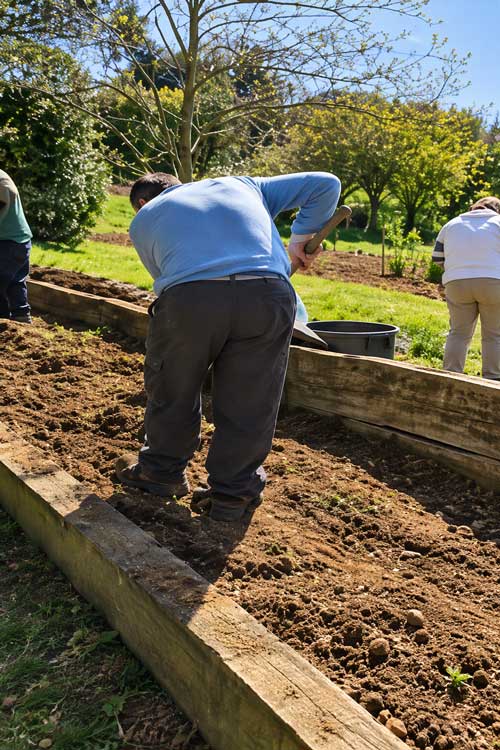
A few kilometres from the bustle of Rome’s tourist attractions and business districts, a tree-lined avenue leads to a social farming cooperative, also accessible by public transport. Beyond the gate, vegetable fields, fruit trees and shaded pergolas mark a change of pace. The atmosphere feels different, not just because of the greenery, but because people seem to have time for one another.
Beside the vegetable fields, yellow notes hang from the branches of a tree. They are messages from children visiting through school projects. One child would like to give the tree a mum so that it will not be alone. Another would share some of the light they receive, thinking the tree needs it more. Some imagine returning to water it; others picture doing their homework beneath its branches to keep it company.
In the farm shop, the connection between food and the land is plain to see. Lettuces grow nearby. During my visits, I am struck by the greetings exchanged between strangers. People come to shop, but there is time to stop and chat.
This is still a business, with production demands and practical constraints. Yet the speed of a transaction is not the only measure of time. Conversation, patience and care for relationships have a place in everyday life.
My research focuses on social farming and its educational programmes. Through a case study of this cooperative and its work with schools, I explore how environmental education can develop into education for sustainability, connecting the environment, work, care and social justice. These reflections draw on observations, interviews, group discussions, project materials and teachers’ accounts. Rather than offering a ready-made solution, they explore what we can learn from everyday practices.
Social farming in Italy
In Italy, social farming combines agriculture with social, educational and inclusion aims. Law No. 141 of 18 August 2015 established a national framework covering employment opportunities for disadvantaged groups, community services, support for therapeutic and rehabilitation programmes, and projects involving environmental and food education, biodiversity conservation and learning about the local area. Education is therefore an explicit part of the framework, not a peripheral activity.
The cooperative combines organic farming, inclusive employment, produce sales and school projects. It is an Italian type-B social cooperative, a business whose social mission includes providing employment for disabled people and people experiencing disadvantage. Production and social purpose are woven into the same daily work.
This raises questions about education and welfare through the places where people live, work and build relationships. The issue is not only what support individuals receive, but how their surroundings enable or hinder learning, recognition and participation.
Where work and learning meet
Children enter a place that does not exist solely for their visit. Crops are grown, people work and relationships with the local community develop. The vegetable garden, shop and workshop spaces are part of everyday life. More than an outdoor classroom, the cooperative is a working social environment where ecological processes meet the labour and care that sustain them.
Moving towards education for sustainability means exploring these connections. Knowledge of nature remains important, but sits alongside questions about how we produce food, use resources, recognise people’s work and share responsibility for care.
An activity does not become education for sustainability simply because it takes place somewhere green. What matters is which connections it helps children understand, which questions it opens up, and how teachers support and build on the experience.
A message to a tree, a reason to return
Over the year, the messages multiply. Some children return with their parents when the family shops at the cooperative and look for their notes. A place first encountered through school becomes part of family life. The relationship continues beyond the workshop.
These messages do not, on their own, demonstrate an understanding of ecological interdependence. They do, however, raise questions about care and reciprocity. Children imagine what they might offer another living being, as well as what they gain from being there.
Returning matters too. The tree is no longer simply the subject of a completed activity. It becomes a familiar presence, somewhere to revisit and find the words left among its branches.
Learning through experience
In another programme, a school spends one day a week at the cooperative with its teachers. The cooperative’s educators plan workshops within the school’s teaching programme. Trees, air, breathing and movement become starting points for exploration through activities, experiments and conversation.
A paper windmill makes the movement of air visible. An experiment helps children recognise that air is present even when they cannot see it. Emotional engagement does not replace knowledge. Understanding develops through hands-on activities, questions and shared reflection.
Another activity observed during the research involves collecting used coffee grounds and reusing them as a growing medium for mushrooms. Instead of being thrown away, the leftovers from an everyday drink become a resource for growing more food. The workshop makes the circular economy tangible, connecting consumption, waste recovery and mushroom cultivation.
The lesson goes beyond sorting rubbish for recycling. It shows how a material can retain its value and enter another production cycle, linking biological processes, consumption habits and agricultural work.
Semi-structured activities also have a clear educational purpose. They give children room to explore, take the initiative and develop relationships without adults determining every step. Guidance and continuity remain important. Regular visits allow children to get to know the place and its people, rather than experiencing it only as a one-off school trip.
Seeing people beyond categories
This attention to relationships also shapes working life. In conversations, people describe an approach based on working with others, rather than simply doing things for them. Harvesting, maintenance and welcoming school groups are part of a shared working and educational life, rather than separate activities assigned according to categories of need.
This does not mean overlooking disability or dispensing with individual support. Categories can help secure rights and direct resources, but become restrictive when they obscure people’s skills, relationships and ability to take the initiative.
Equity does not mean treating everyone identically. It means creating conditions in which each person can contribute and be recognised. Simply being in the same place is not enough. The roles people can take on, the value placed on their work and the relationships they can build all matter.
Changing environments, learning what connects us
Neither contact with nature nor good intentions guarantees inclusion. Accessible spaces, sufficient time, educational support, continuity and public investment are needed. Social farming cannot replace public welfare provision or resolve the structural inequalities behind longstanding and emerging forms of poverty. It can, however, offer settings in which to explore how work, education and care can be organised together.
This case invites us to look beyond a view of outdoor education as simply moving activities out of the classroom. At the cooperative, growing food, working, consuming and caring are part of the same experience. Education for sustainability means understanding these connections and asking what enables everyone to take part.
It also invites us to rethink social support beyond an approach that treats people primarily as recipients of assistance. Disabled people and people experiencing disadvantage can take on valued roles, contribute to shared work and help shape decisions about their lives. Rather than asking them to fit into unchanged settings, the aim is to change spaces, schedules, opportunities and relationships so that they can shape their own lives and contribute to collective life.
Inclusion calls for care that does not reduce people to categories of need, while recognising differences and providing individual support. Sustainability becomes a way of rethinking our environments, working lives and relationships together.
The child returning to find a message left on the tree offers an image to hold on to. This is no longer just a place where an activity happened. It has become part of an ongoing relationship. Education for sustainability also means nurturing that possibility, recognising our interdependence and creating the conditions to care for what connects us.
Connect with us
Whatever your reasons for wanting to connect with us, you can contact us via email or social media on the addresses below
CSGD email
CSGD on Bluesky
CSGD on LinkedIn
Sign up to our mailing list to receive the latest news on our research, events and publications.
Sign up to our mailing list


Explore

Undergraduate
Postgraduate
Policy
-
Follow us on Social media
-


